|
Getting your Trinity Audio player ready...
|
Let’s be honest.
If you run a business today, marketing can feel confusing.
One person tells you to invest in newspaper ads and hoardings.
Another says everything should be online — ads, social media, SEO, reels, everything.
And somewhere in between all this advice, you’re just trying to answer one simple question:
“What actually works for my business today?”
The truth is, marketing in 2026 isn’t about choosing sides.
It’s about understanding where your customers are paying attention.
Let’s break it down in the simplest way possible.
Traditional Marketing: The Old-School Approach We All Recognize
Traditional marketing is what businesses relied on for decades.
You’ve seen it everywhere:
- Ads in newspapers
- Billboards on busy roads
- Flyers handed out near markets
- Radio announcements
- Television commercials
For a long time, this was the only way brands could reach people.
And even today, it still has its place.
Why Some Businesses Still Prefer It
Traditional marketing has something digital ads often struggle with — a sense of physical presence.
When people see a billboard on a highway or an ad in a newspaper, it feels official. Established. Real.
Here’s why businesses still use it:
| Why Businesses Like It | What It Means |
| Strong brand visibility | A billboard can reach thousands of people daily |
| Higher perceived trust | Print media often feels more credible |
| Good for local awareness | Works well for local shops and events |
| Physical presence | People remember what they physically see |
For example, if a new retail store opens in a city, a few newspaper ads or outdoor hoardings can create strong local awareness quickly.
But traditional marketing also has clear limitations now.
Where Traditional Marketing Starts Struggling
The biggest challenge is simple:
You don’t really know what’s working.
If you place an ad in a newspaper, you might reach thousands of readers — but you won’t know how many actually became customers.
Here are some common issues businesses face:
| Challenge | Why It Matters |
| High cost | TV, radio, and billboards require large budgets |
| Hard to track results | You can’t easily measure conversions |
| Broad targeting | Your ad reaches everyone, not just potential buyers |
| No flexibility | Once printed, the message cannot be changed |
In today’s fast-moving marketing world, this lack of flexibility can be a serious drawback.
That’s why many businesses started shifting toward digital channels.
Digital Marketing: Where Most Customers Already Are
Think about how people behave today.
When someone wants to buy something, they rarely walk into a store blindly.
Instead, they:
- Search on Google
- Check reviews
- Browse Instagram pages
- Watch YouTube videos
- Ask friends online
Most buying decisions now begin on the internet.
That’s exactly why digital marketing has become such a powerful tool.
Why Digital Marketing Works So Well Today
Digital marketing allows businesses to reach people more precisely and more efficiently.
Instead of showing your message to everyone, you can focus on people who are more likely to be interested.
Here’s why brands rely on it so heavily:
| Advantage | Why Businesses Value It |
| Targeted audience | Ads reach people based on interests and behavior |
| Flexible budgets | Even small daily budgets can generate results |
| Clear analytics | You can see clicks, leads, and conversions |
| Quick adjustments | Campaigns can be changed instantly |
| Constant visibility | Your brand stays active online every day |
One of the biggest benefits is accessibility.
Small businesses can compete with larger brands without needing massive budgets.
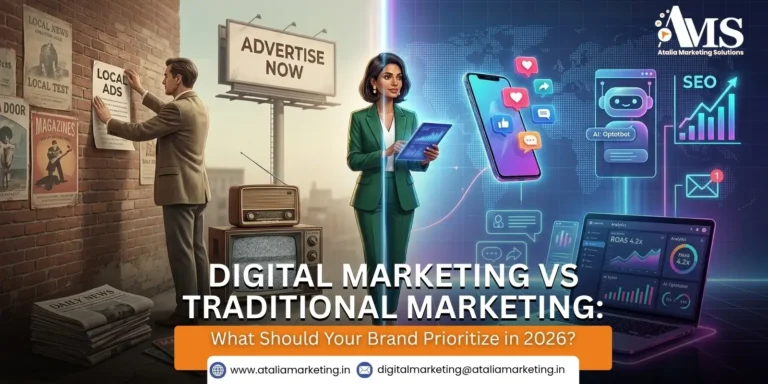
Traditional vs Digital Marketing: A Simple Comparison
| Factor | Traditional Marketing | Digital Marketing |
| Cost | Usually high | Flexible |
| Targeting | Broad audience | Highly specific |
| Tracking | Limited data | Detailed analytics |
| Flexibility | Hard to change | Easy to adjust |
| Customer interaction | Mostly one-way | Two-way communication |
Both approaches serve different purposes, but digital marketing offers something modern businesses need most:
control and measurable results.
What Today’s Customers Actually Do Before Buying
Consumer behavior has changed dramatically over the past decade.
According to research:
- 81% of shoppers research online before making a purchase
- 93% of online experiences begin with a search engine
Sources
https://www.thinkwithgoogle.com
https://blog.hubspot.com/marketing/marketing-statistics
This means many customers will interact with your brand online first, even if they eventually buy offline.
The Budget Reality for Businesses
Let’s talk about something every business owner worries about — costs.
Traditional marketing often requires a large upfront investment.
Here’s a rough comparison:
| Marketing Type | Typical Cost Range |
| Newspaper ad | ₹20,000 – ₹2,00,000 |
| Billboard | ₹50,000 – ₹5,00,000 monthly |
| TV advertising | ₹1,00,000+ depending on slot |
| Social media ads | ₹200 – ₹5,000 daily |
| Google search ads | Pay per click |
The biggest difference isn’t just the price.
It’s control.
Digital campaigns allow businesses to start small, test strategies, and increase budgets only when results appear.
So What Should Businesses Focus on in 2026?
The answer depends on your goals.
Traditional marketing may still be useful if your goal is:
- mass awareness
- local visibility
- large-scale brand recognition
But digital marketing is usually better if your focus is:
- generating leads
- engaging customers
- tracking marketing performance
- building long-term online visibility
For most businesses today, the smartest approach is digital-first marketing with selective traditional support.
How Atalia Marketing Solutions Helps Businesses Navigate This
Many business owners know digital marketing matters.
What they struggle with is where to start.
Should you focus on social media?
SEO?
Ads?
Content?
This is where Atalia Marketing Solutions supports brands.
Instead of jumping straight into ads or posting random content, the team starts with a few simple questions:
- Who are your customers?
- What problems does your product solve?
- Where do your customers spend time online?
From there, the strategy becomes much clearer.
The goal isn’t just to create posts or run ads.
It’s to help businesses build consistent, measurable growth online.
Is digital marketing better than traditional marketing?
Digital marketing is often more effective for modern businesses because it allows targeted advertising, measurable results, and flexible budgets. Traditional marketing still works for large-scale brand awareness.
Does traditional marketing still work today?
Yes. Traditional marketing can still be useful for local promotions, events, and large brand campaigns. However, most businesses now combine it with digital marketing strategies.
Why are businesses shifting toward digital marketing?
Businesses prefer digital marketing because it provides detailed performance data, targeted audiences, and the ability to adjust campaigns quickly.
How much should a small business spend on marketing?
Many small businesses begin with a monthly digital marketing budget between ₹5,000 and ₹25,000 and increase spending as campaigns start delivering results.
Can a business succeed without digital marketing today?
It’s possible, but increasingly difficult. Since many customers research online before buying, businesses without digital presence often miss potential opportunities.
Final Thought
Marketing isn’t about choosing between old and new methods.
It’s about understanding how people discover brands today.
And right now, most customers start that journey online.
Businesses that adapt to this shift stay visible.
Businesses that ignore it slowly disappear from the conversation.
If 2026 is the year you want your brand to grow, the right marketing strategy can make that journey far smoother — and far more effective.