|
Getting your Trinity Audio player ready...
|
AI Overviews have changed what it means to be visible online. And strangely enough, the businesses that ignored basic SEO are now feeling it the most.
I have heard some version of the same question several times lately.
“Ma’am, with AI giving people answers directly, does SEO even matter anymore?”
It usually comes from a founder or business owner who has noticed something odd. Rankings look reasonably stable. The SEO report doesn’t look disastrous. And yet, website traffic is slipping.
So naturally, the conclusion is: SEO is dying.
I don’t agree.
SEO hasn’t died. What has died—or at least should have died by now—is the old habit of treating SEO as a collection of tricks.
Put the keyword here. Add it again there. Build some backlinks. Publish four blogs a month. Wait for Google.
That approach was already becoming weak. AI search has simply exposed it faster.
Today, Google can answer a question before someone reaches your website. AI Overviews appear above traditional search results. People are also asking ChatGPT, Gemini and Perplexity questions they would once have typed into Google.
That changes the journey considerably.
But here is the interesting part.
All these systems still need information from somewhere.
They need businesses, experts, websites and sources they can understand and, more importantly, trust.
So the question is no longer only:
“How do I rank?”
It is also:
“Why should an answer engine trust my business enough to use me as a source?”
That is a much better question.
And it brings us straight back to the basics.
Over the past few months, I have had several conversations around this with founders, marketers and business owners. Instead of turning this into another “10 SEO trends” article, I thought I would answer some of the questions exactly the way I would during a client meeting or strategy discussion.
“My rankings are the same, but my traffic has dropped. How is that possible?”
Because ranking and visibility are no longer quite the same thing.
Imagine that you have been standing in the same shop for years.
Your shop hasn’t moved.
But suddenly somebody builds a huge information desk directly in front of it and starts answering customers’ questions before they reach your door.
Technically, you are still in the same location.
Practically, fewer people are reaching you.
That is roughly what AI Overviews can do to informational searches.
A person searches for an answer. Google gives them a summary. They get what they need and leave without clicking anything.
So yes, you can retain your ranking and still lose clicks.
The response, however, should not be to declare SEO dead.
Look at the questions bringing people into your category.
Are you answering them clearly?
Can somebody understand your answer in thirty seconds?
Are you saying something useful, or have you written 1,500 words because somebody told you that long-form content ranks better?
There is a lot of content online that takes six paragraphs to arrive at a point that could have been made in two.
That style of writing has become a liability.
If an AI system is going to quote or reference your information, make the useful part easy to find.
Remember:
SEO helps machines find and understand you. AEO helps them use your answers.
You need both.
“But I’m a small company. How am I supposed to compete with brands spending crores?”
This is actually one of the reasons I find the current shift interesting.
You may not be able to outspend a multinational.
But you can absolutely out-explain one.
Large companies often have beautifully designed websites that say surprisingly little.
Everything is “innovative”, “transformative”, “next-generation” and “customer-centric”.
Then you finish reading the page and still don’t know what they actually do differently.
A smaller business has an opportunity here.
Suppose you manufacture a specialised industrial component.
Instead of writing:
“We deliver world-class innovative solutions designed to meet evolving industry requirements.”
Explain something only someone who actually works in your industry would know.
What causes a common failure?
What mistake do buyers repeatedly make?
What should a procurement team check before selecting the product?
What changes the cost?
What happens during installation?
That information demonstrates experience.
And experience is difficult to fake convincingly.
The internet already has enough generic content.
Specific knowledge is becoming far more valuable.
“Our work is good. Our clients are happy. Why do we still look invisible online?”
This happens more often than people realise.
The company may genuinely be excellent offline.
But online, its identity is scattered.
The website describes the company one way.
LinkedIn describes it another way.
An old directory has an outdated address.
The founder’s profile talks about services the website barely mentions.
Case studies are sitting inside PDFs nobody can find.
Awards appear in social media posts but nowhere on the website.
Reviews tell one story while the corporate copy tells another.
A human being can sometimes connect those dots.
Machines are less forgiving.
If you want your business to be understood clearly, make the evidence easier to assemble.
Before commissioning another batch of blogs, clean up your digital identity.
Make the basics consistent.
Then create genuinely useful material around the subjects you want to be known for.
One strong resource written from experience is worth far more than ten articles written simply because “we need blogs for SEO.”
A Thought
I don’t think businesses should panic about AI search.
I do think they should stop assuming that yesterday’s SEO checklist will carry them through the next five years.
Search is changing.
The interface is changing.
The click is changing.
The way people discover brands is changing.
But something underneath all of this has remained remarkably consistent.
Be useful.
Know your subject.
Make your expertise visible.
Back up your claims.
Make your information easy to understand.
And make sure machines can actually find it.
Those were good SEO principles before anybody started talking about AEO.
They are even more important now.
So, no, I wouldn’t hold a funeral for SEO.
I would give it a promotion.
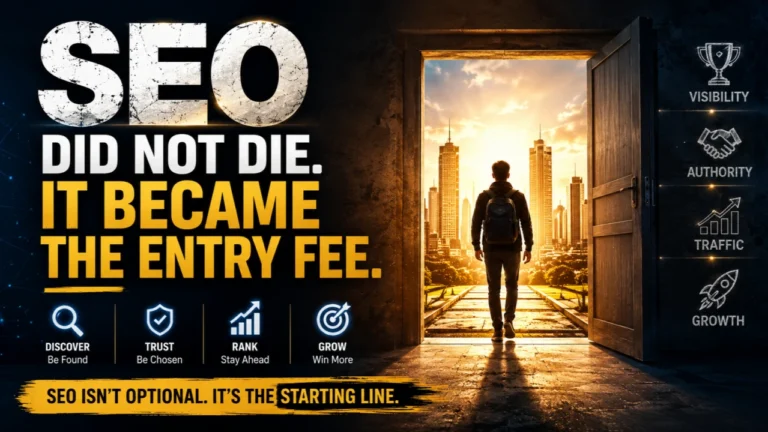
SEO is now the entry fee.
AEO is what you start thinking about once you are inside.
And the brands that understand that distinction early will have a considerable head start.
I regularly share observations like these from client discussions, pitches, campaigns and the everyday realities of building brands in a rapidly changing digital landscape.
If this gave you something useful to think about, follow along. I have plenty more conversations from the ground that are worth bringing here.
Cheers