
|
Getting your Trinity Audio player ready...
|
My reflections on the Prime Minister’s vision for Viksit Bharat 2047
There are some speeches we listen to and move on. And then some speeches make you stop for a moment and think about where the country is actually heading.
For me, Honourable Prime Minister Sri Narendra Modi’s Independence Day address from the Red Fort on 15 August was one of those moments.
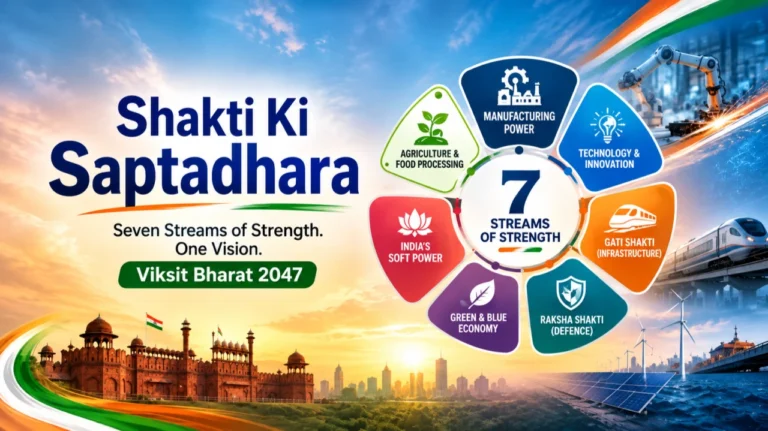
What caught my attention was his reference to “Shakti Ki Saptadhara” — seven streams of strength that can shape India’s next phase of growth. I see these seven areas less as seven separate government priorities and more as seven pieces of one much larger picture.
If India has to become a Viksit Bharat by 2047, all seven will have to move together. And more importantly, citizens, businesses, entrepreneurs, professionals and young Indians will all have a role to play.
So, what do these seven streams mean to me?
1. Manufacturing — Build in India, Compete with the World
India has a huge opportunity in manufacturing. But the real test is not simply how much we manufacture. It is whether what we manufacture can stand confidently in a global market.
Cost matters. Quality matters. Scale matters. From electronics and engineering to defence equipment, clean-energy technologies and hydrogen systems, India has the opportunity to become much more than a large consumer market.
We need to become a country that the world comes to for products, technology and capability.
That is where Make in India can become much bigger than a slogan.
2. Agriculture & Food Processing — Take the Farm to the World
India’s agricultural strength is enormous, but there is still a lot of value left on the table. We grow. Others often process, package, brand and sell. That needs to change.
There is a real opportunity in food processing, cold chains, storage, packaging and exports. Our millets, spices, fruits, flowers and traditional food products can travel much further than they do today. For farmers, entrepreneurs and food businesses, this can mean a very different kind of opportunity.
3. Technology & Innovation — We Cannot Always Be the Market
This one is particularly important for India’s young population. AI, robotics, quantum technology, space, semiconductors, data centres and next-generation communications are already changing the way economies work.
India has shown the world what is possible through UPI and Digital Public Infrastructure.
Can we become equally good at creating the technologies that will define the next 20 years?
I believe we can. But that requires more research, more risk-taking, stronger industry-academia connections and, importantly, a willingness to experiment.
4. Gati Shakti — Connect Everything Better
Sometimes development is not about creating something completely new. Sometimes it is about making everything work together better.
A manufacturer needs roads and railways. A farmer needs logistics. An exporter needs ports. A city needs reliable public transport. An industry needs efficient movement of goods.
Gati Shakti, in my view, is about removing those invisible barriers that increase the cost and time of doing business in India. A faster, better-connected India is automatically a more competitive India.
5. Raksha Shakti — Strength Begins with Self-Reliance
The last few years have reminded the world that strategic dependence can become a serious weakness. India therefore needs stronger domestic capabilities in defence manufacturing and technology.
But I see the opportunity going beyond simply meeting our own requirements.
Indian companies can potentially become suppliers of sophisticated defence technologies to friendly countries. That means more manufacturing, more research, more skilled jobs and stronger strategic capability.
Atmanirbharta does not mean standing alone. It means being strong enough to choose our partnerships.
6. Green & Blue Economy — An Area I Believe Will Define India’s Future
This is the stream I personally find particularly exciting. India needs more energy. Our economy will continue to grow and millions more people will aspire to better standards of living.
So the question is: how do we meet that growing demand without compromising our future?
Renewable energy, energy storage and green hydrogen will have an important role here.
Green hydrogen, in particular, can connect several parts of India’s economy — renewable power, manufacturing, fertilisers, steel, mobility, ports and exports.
And then there is the Blue Economy.
With our enormous coastline, India has opportunities in ports, shipping, fisheries, marine technology and coastal development that are still waiting to be fully explored.
7. India’s Soft Power — Our Identity Is Also an Asset
The seventh stream is very different from the others, but perhaps just as powerful.
Yoga has already taken India to every corner of the world. Ayurveda, Indian cuisine, handicrafts, films, music, tourism, animation, gaming and our cultural heritage can do much more.
Our culture has always travelled well. Now we need to think about how it can create economic value as well.
There is nothing wrong with turning our cultural strengths into global brands.
In fact, I think we should.
But What Does Saptadhara Mean for Me — and You?
This is the question I kept thinking about after hearing the Prime Minister’s speech.
Because ultimately, a country’s transformation cannot be achieved by the government alone.
- A policy can create an opportunity. Someone has to act on it.
- An entrepreneur has to build the company.
- An engineer has to design the solution.
- A researcher has to solve the problem.
- A manufacturer has to improve the product.
- A farmer has to adopt better practices.
- A young person has to acquire the skills that tomorrow’s economy will demand.
- And professionals like us have to ask ourselves a fairly simple question:
What can I contribute?
That, perhaps, is where the idea of Saptadhara becomes much more meaningful.
As we look towards Viksit Bharat 2047, I believe the biggest contribution each of us can make is not simply to talk about India’s future.
It is to become a small part of building it.
Cheers