
|
Getting your Trinity Audio player ready...
|
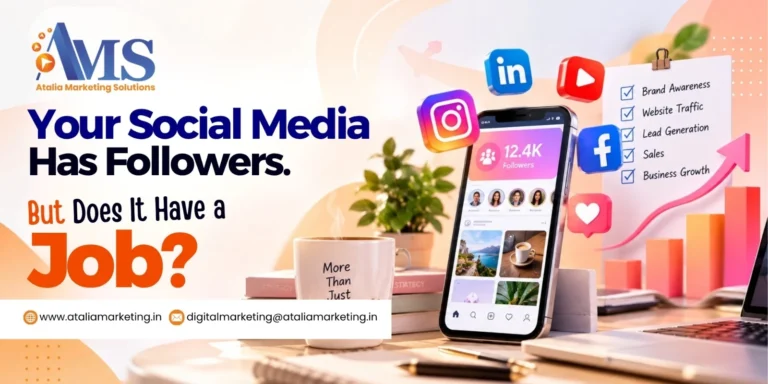
Let’s say your business has 20,000 followers.
Your posts are going out regularly.
The Instagram grid looks good.
You’ve got reels, carousels, stories and the occasional trend.
And yet, when you ask a simple question – “What is social media actually doing for the business?” – the answer isn’t very clear.
That’s more common than you’d think.
Because social media can look busy without actually being strategic.
At Atalia Marketing, this is one of the first things we’d want to understand before deciding what a business should post next.
Not:
“How many posts should we create?”
But:
“What does this business need social media to do?”
That question changes the entire strategy.
Social Media Needs a Job
For one business, social media might need to create awareness.
For another, it might need to generate enquiries.
A restaurant may need to get people through the door.
An education company may need to build trust before someone enquires.
A B2B company may need to demonstrate expertise.
An e-commerce brand may need to turn product discovery into sales.
These businesses shouldn’t have the same social media strategy just because they’re all using Instagram.
Atalia works across social media marketing, content marketing, PPC, SEO, websites and other digital services.
That gives us a useful starting point:
The platform isn’t the strategy. The business objective is.
The First Thing We’d Ask at Atalia: What Are We Trying to Achieve?
Before creating a content calendar, we’d want to understand the business.
What are you selling?
Who are you trying to reach?
How long does the customer take to make a decision?
Where do they currently discover you?
What happens after someone interacts with your social media?
And most importantly:
What would make you say that social media is working?
If the answer is “more followers,” we’d probably go one step further.
Because followers are an audience metric.
They’re not automatically a business metric.
If the objective is lead generation, we might care more about enquiries, qualified leads, website visits, click-through rates and conversions.
If the objective is awareness, reach and engagement become more relevant.
The metric needs to match the job.
The Problem with Posting for the Sake of Posting
Here’s a social media calendar that many businesses unknowingly follow:
Monday — motivational quote.
Tuesday — product post.
Wednesday — festival greeting.
Thursday — service post.
Friday – trending reel.
Repeat.
There’s nothing wrong with any individual post.
The problem is that there’s no obvious reason for the sequence.
Atalia’s approach would be to work backwards.
Start with the business objective.
Then identify the audience.
Then identify what that audience needs to know.
Then build content around those questions.
That could result in very different content.
Instead of constantly saying “We provide X service,” we might create content around:
- Problems customers commonly face
- Questions prospects ask before buying
- Common mistakes
- Product or service demonstrations
- Customer experiences
- Industry insights
- FAQs
- Case studies
- Comparisons
- Behind-the-scenes content
- Stronger reasons to choose the brand
Now the content has a purpose.
Your Audience Doesn’t Need Another Advertisement
People already know businesses want to sell to them.
That’s why every post doesn’t need to scream:
BUY NOW.
Sometimes the better approach is to help people understand something.
Suppose you’re a real-estate company.
Instead of posting another graphic saying “Luxury Properties Available,” you could explain what buyers should check before investing in a particular location.
Or explain the difference between two types of properties.
Or answer a question buyer repeatedly ask.
Or show what makes a development different.
That kind of content gives people a reason to spend time with your brand.
And over time, that familiarity can become valuable when they’re ready to make a decision.
Atalia Wouldn’t Look at Social Media in Isolation
This is where the strategy becomes more interesting.
Imagine someone sees your Instagram post.
They become curious.
They click your profile.
Then they visit your website.
What happens next?
Does the website explain the same message?
Can they easily understand the product or service?
Is there a clear next step?
Can they find reviews or proof?
Can they contact you easily?
If the answer is no, improving the Instagram post alone won’t solve the problem.
The customer journey has moved beyond social media.
That’s why Atalia’s service mix includes SEO, PPC, social media, content marketing and web development.
The goal isn’t to push every service onto every client.
It’s to identify where the journey is breaking.
A Real Example: Social Media Was Only One Part of the Solution
Atalia’s documented work with a real-estate company is a useful example of this approach.
The project didn’t rely on social media alone.
Atalia developed the company’s social media presence and ran targeted campaigns, but the wider strategy also included a website revamp and SEO, content marketing, email campaigns, Google Ads and retargeting.
That makes sense when you think about how someone actually buys property.
They may discover a project through social media.
Then search for the company.
Visit the website.
Look at the properties.
Leave.
Receive an email.
See a retargeting ad.
Return to the website.
And eventually enquire.
Social media helped start the journey.
It wasn’t responsible for the entire journey.
That’s the distinction businesses often miss.
What If Your Followers Aren’t Converting?
Don’t immediately conclude that social media doesn’t work.
Instead, Atalia would look at the journey.
Are the right people seeing the content?
Are people engaging?
Are they visiting the profile?
Are they clicking through?
What happens on the website?
Are the landing pages relevant?
Is the CTA clear?
Are enquiries coming in?
Are those enquiries qualified?
Where the drop-off happens tells you what needs fixing.
Sometimes the issue is the content.
Sometimes it’s targeting.
Sometimes it’s the offer.
Sometimes it’s the landing page.
Sometimes it’s the conversion process.
And sometimes social media is actually doing its job — the business simply isn’t measuring the right outcome.
Not Every Business Needs to Chase Every Trend
There’s always a new format.
A new reel trend.
A new platform.
A new algorithm update.
A new content style that everyone suddenly says businesses “must” use.
Atalia’s approach should be more practical.
If a particular format helps the business reach the right audience, use it.
If it doesn’t, don’t force it simply because everyone else is doing it.
The question isn’t:
“What’s trending?”
It’s:
“What helps our audience move closer to the business?”
That could be a reel.
It could be a LinkedIn article.
It could be a case study.
It could be a simple FAQ post.
It could even be a well-written landing page.
Good strategy decides the format.
Not the other way around.
What Atalia Would Build
If Atalia were brought into a business that had plenty of followers but wasn’t seeing enough business value from social media, the first step wouldn’t necessarily be to increase the posting frequency.
We’d look at:
- The objective
What is social media supposed to achieve?
- The audience
Who are we actually trying to reach?
- The content
Are we giving people useful reasons to engage?
- The channel
Are we using the platforms where the audience actually spends time?
- The journey
What happens after someone interacts with us?
- The conversion
Is there a clear next step?
- The data
What is actually happening after people see the content?
Only then would we decide what needs to change.
Followers Are Not the Strategy
A large audience can be useful.
But an audience without direction doesn’t automatically create business growth.
Your social media should have a role.
It should know who it is talking to.
It should know what it wants that person to do.
And it should connect with the rest of your digital presence.
That’s how Atalia would look at social media, too.
Not as a monthly requirement to “keep the page active.”
But as one part of a larger digital marketing strategy.
Because the real question isn’t:
“How many people follow us?”
It’s:
“What happens because they do?”